
 United Kingdom
 India

Understanding the Condition
1What Is Liver, Pancreas & Biliary Surgery?
Hepatobiliary and pancreatic surgery covers procedures performed on the liver, pancreas, gallbladder and bile ducts. The objective depends on the diagnosis: removing a tumour, clearing an obstructing gallstone or bile duct stricture, treating pancreatic disease, or replacing a failing liver with a transplant. These organs work closely together and share a complex blood supply and drainage system, which is why hepatobiliary surgery is considered one of the more technically demanding areas of general surgery, and why the experience of the specific surgical team matters a great deal.
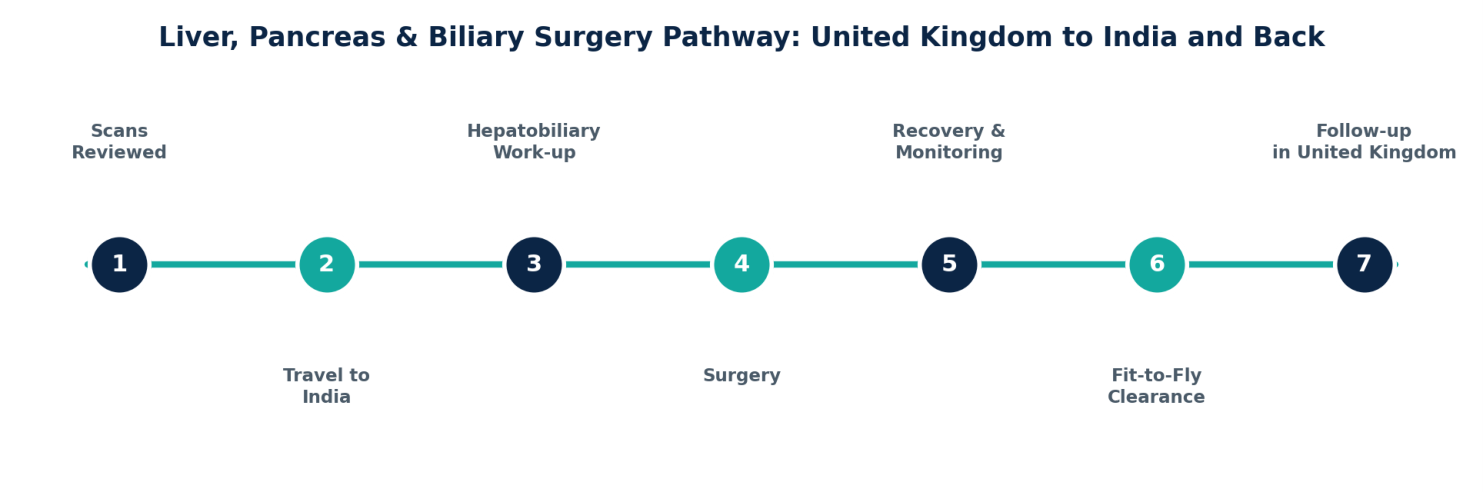
2Common Conditions for Which United Kingdom Patients May Consider Hepatobiliary Surgery in India
Gallstones and Gallbladder Disease
Gallstones causing pain, inflammation or obstruction are commonly treated with laparoscopic gallbladder removal (cholecystectomy).
Bile Duct Stones and Strictures
Stones or narrowing of the bile ducts can cause jaundice, infection or pain, often treated endoscopically or, in more complex cases, surgically.
Liver Tumours (Benign and Malignant)
Tumours may be primary liver cancers or spread from another cancer (commonly colorectal cancer); treatment depends on tumour number, size, location and liver function.
Pancreatic Tumours and Pancreatic Cancer
Tumours of the pancreas may be benign, precancerous, or malignant, with treatment ranging from surveillance to complex resection depending on the diagnosis.
Chronic and Acute Pancreatitis
Inflammation of the pancreas, sometimes with complications such as cysts or duct blockage, may require endoscopic or surgical treatment in selected cases.
End-Stage Liver Disease Requiring Transplant
Advanced cirrhosis or liver failure from various causes may require evaluation for liver transplantation, including living-donor options.
Bile Duct Cancer (Cholangiocarcinoma)
A cancer of the bile duct system requiring specialised surgical and oncological assessment.
Hydatid Cysts and Liver Abscesses
Parasitic cysts or infected collections in the liver, relatively more common in some regions, may require drainage or surgical removal.
3Does Every Condition Need Surgery?
No. This is one of the most important principles for a United Kingdom patient considering travelling overseas. Depending on the diagnosis, appropriate non-surgical treatment may include:
- Medication for pancreatitis or selected liver conditions
- Endoscopic treatment (ERCP) for selected bile duct stones or strictures instead of surgery
- Interval imaging surveillance for small, stable, asymptomatic liver lesions
- Non-surgical oncological treatment (chemotherapy, targeted therapy, or locoregional therapy) for selected tumours not suitable for resection
- Nutritional and medical optimisation before any surgery is considered
A finding on ultrasound, CT or MRI does not automatically mean surgery is necessary. A hepatobiliary specialist team should evaluate whether the patient’s diagnosis, liver function, and overall health justify surgery, and what extent of surgery is genuinely required.
Diagnosis & Decision
4When May Surgery Be Recommended?
- A tumour is confined to the liver or pancreas and can be safely removed with adequate remaining organ function
- Gallstones are causing recurrent pain, infection, or complications
- A bile duct blockage cannot be adequately relieved endoscopically
- Chronic pancreatitis is causing disabling pain or complications not responding to other treatment
- Liver function has declined to the point that transplantation is the most appropriate option
- A cyst or abscess is large, symptomatic, or at risk of rupture
5Warning Signs United Kingdom Patients Should Not Ignore Before Travelling to India
- Yellowing of the skin or eyes (jaundice)
- Severe abdominal pain, especially in the upper abdomen
- Persistent vomiting with abdominal pain
- Fever with abdominal pain or jaundice
- Unexplained weight loss
- Vomiting blood or passing black, tarry stools
A patient with severe abdominal pain, jaundice with fever, or signs of gastrointestinal bleeding should seek immediate local emergency care in the United Kingdom rather than delaying to arrange overseas treatment.
6Tests Usually Required Before Liver, Pancreas or Biliary Surgery
Ultrasound
A first-line test for gallstones, liver lesions and bile duct dilation.
CT or MRI (Including MRCP)
Provides detailed imaging of the liver, pancreas and bile duct anatomy, essential for surgical planning.
Liver Function Tests
Blood tests assessing how well the liver is working, important both for diagnosis and for planning the safe extent of any liver surgery.
Tumour Markers
Blood tests that may support diagnosis and monitoring for selected liver and pancreatic cancers.
Endoscopic Ultrasound or ERCP
Used selectively for detailed pancreatic or bile duct assessment, and sometimes as treatment itself.
Biopsy
Tissue sampling to confirm or exclude cancer where relevant.
Surgery Options
7Major Types of Liver, Pancreas and Biliary Surgery Available in India
Laparoscopic Cholecystectomy
Minimally invasive removal of the gallbladder, the standard treatment for symptomatic gallstones.
Liver Resection (Hepatectomy)
Surgical removal of part of the liver containing a tumour, performed openly or laparoscopically/robotically depending on the case, with careful planning to preserve enough healthy liver tissue.
Pancreatic Resection (Whipple Procedure and Others)
Complex surgery to remove part or all of the pancreas along with, where necessary, surrounding structures, for selected pancreatic tumours.
Bile Duct Reconstruction
Surgical repair or reconstruction of the bile duct system for strictures, injury, or cancer.
Living-Donor and Deceased-Donor Liver Transplantation
Replacement of a failing liver, including specialised living-donor programmes where a portion of a healthy donor’s liver is used.
Cyst and Abscess Drainage or Excision
Surgical or image-guided drainage of liver cysts or abscesses, or complete surgical removal where appropriate.
8Minimally Invasive and Robotic Hepatobiliary Surgery
Many gallbladder and selected liver and pancreatic procedures can now be performed laparoscopically or robotically rather than through large open incisions, potentially reducing blood loss, pain and recovery time in appropriately selected patients. Complex liver resections, major pancreatic surgery, and transplantation, however, often still require an open approach for safety, particularly with larger or more centrally located tumours.
9Liver Function Assessment and Surgical Planning
Advanced Indian hepatobiliary centres use detailed volumetric imaging to calculate exactly how much liver can be safely removed while leaving enough functioning tissue behind, along with specialised interventional radiology support for complex cases. A useful question for United Kingdom patients is not “Can the tumour be removed?” but “How much healthy liver or pancreas will remain afterward, and is that enough for me to recover safely?”
Can my scans be reviewed before I travel from the United Kingdom?
Risks & Recovery
10Risks and Possible Complications of Liver, Pancreas and Biliary Surgery
- Bleeding
- Infection
- Bile leak
- Pancreatic fluid leak (after pancreatic surgery)
- Liver failure if insufficient healthy liver tissue remains
- Blood clots
- Diabetes or digestive changes after pancreatic surgery
- Delayed gastric emptying
- Anaesthesia-related complications
- Need for further surgery or intervention
The risk profile of a routine laparoscopic gallbladder removal is very different from that of major liver resection, pancreatic surgery, or liver transplantation. Patients should request procedure-specific risk information rather than relying on generic complication percentages.
11Recovery After Surgery
Early Phase
- Pain control
- Close monitoring of liver or pancreatic function
- Drain and wound monitoring
- Early mobilisation where appropriate
- Monitoring for bleeding, leak, or infection
Following Weeks
- Progressive activity increase
- Nutritional support and dietary adjustment
- Wound care
- Medication adjustment
- Monitoring liver or pancreatic function as it recovers
Longer-Term Recovery
Recovery from a laparoscopic gallbladder removal is typically measured in days to weeks, while recovery from major liver resection, pancreatic surgery, or liver transplantation typically takes several months, with liver function often continuing to improve for up to a year after major resection or transplant.
12Recovery Support and Nutritional Rehabilitation
- Nutritional counselling, particularly after pancreatic surgery
- Gradual return to normal activity
- Monitoring for diabetes or digestive enzyme needs after pancreatic surgery
- Immunosuppression education for transplant patients
- Psychological support where relevant
- Long-term surveillance planning for cancer patients
13When Can Patients Return to Work?
This depends heavily on the extent of surgery and occupation. Laparoscopic gallbladder removal often allows return to desk-based work within one to two weeks, while major liver or pancreatic resection typically requires six to eight weeks, and liver transplantation requires a longer, individually planned recovery before returning to work.
Travel Home & Follow-Up
14How Long Should a United Kingdom Patient Remain in India After Hepatobiliary Surgery?
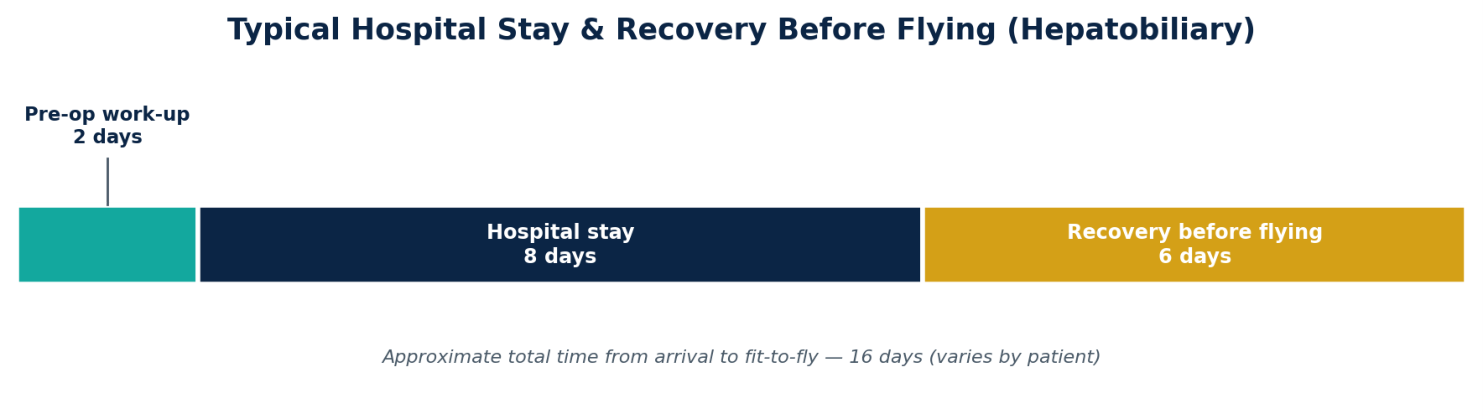
The appropriate period depends heavily on the extent of surgery. A straightforward gallbladder removal may allow travel home within a week, while major liver or pancreatic resection, and especially liver transplantation, requires a much longer stay in India for monitoring before the treating team confirms fitness to travel. A United Kingdom patient should not book an inflexible return flight based solely on the expected hospital discharge date.
15Flying Back to the United Kingdom After Hepatobiliary Surgery in India
- Fit-to-fly clearance from the treating hepatobiliary surgical team
- Liver or pancreatic function assessment before flying
- Medication timing, including immunosuppression for transplant patients
- Wound and drain assessment
- Hydration
- Blood-clot prevention
- Airport wheelchair assistance if needed
- Suitable seating
Transplant patients and those recovering from major resections may need specific clearance regarding infection risk, immunosuppression, and cabin environment before flying.
16What Medical Information Should You Take Back to the United Kingdom from India?
- Discharge summary
- Complete operative report
- Final diagnosis and histopathology if applicable
- Relevant imaging (CT/MRI/MRCP)
- Liver and pancreatic function test results
- Medication list, including immunosuppression regimen if applicable
- Transplant/donor documentation if applicable
- Follow-up and surveillance schedule
- Emergency warning signs
- Treating hepatobiliary team’s contact/follow-up pathway
17Follow-Up After Returning to the United Kingdom from India
- Wound assessment
- Liver or pancreatic function blood tests
- Imaging surveillance if relevant (especially for cancer or transplant patients)
- Medication and immunosuppression review if applicable
- Nutritional and diabetes monitoring after pancreatic surgery
- Coordination with local physician for long-term care
- Cancer surveillance planning if applicable
18How Successful Is This Surgery?
There is no meaningful single “success rate” for liver, pancreas or biliary surgery. Outcomes depend on the specific diagnosis, extent of disease, underlying liver function, age, and overall health. The expected outcome of a routine gallbladder removal cannot reasonably be compared with major liver resection, complex pancreatic surgery, or liver transplantation. Patients should be cautious about websites offering one universal success percentage, and should ask for outcomes specific to their exact diagnosis and the extent of surgery planned.
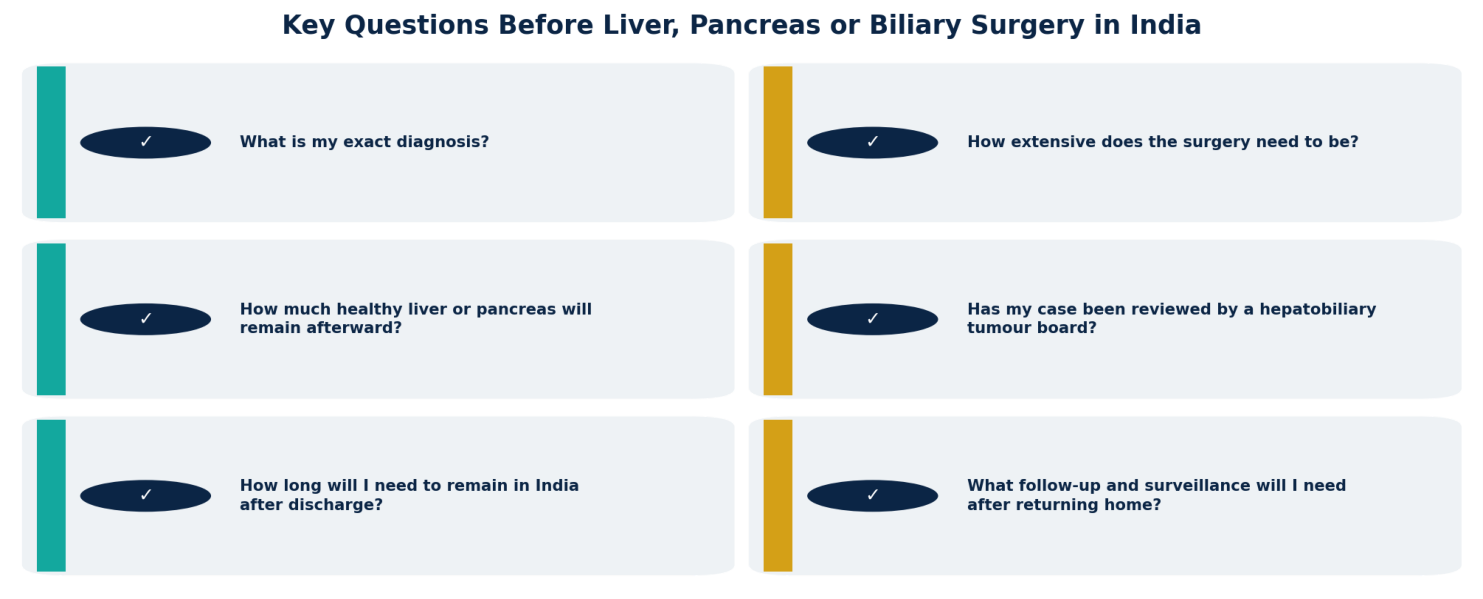
19Questions United Kingdom Patients Should Ask Before Agreeing to Surgery in India
- What is my exact diagnosis?
- How extensive does the surgery need to be?
- How much healthy liver or pancreas will remain afterward?
- Is a minimally invasive or robotic approach appropriate for me?
- Has my case been reviewed by a hepatobiliary tumour board?
- What are the major risks in my specific case?
- How frequently does this team perform this exact procedure?
- Will I need chemotherapy or other treatment in addition to surgery?
- How long will I be hospitalised, and how long in India afterward?
- When will I be fit to fly back to the United Kingdom?
- What follow-up and surveillance will I need after returning home?
?Frequently Asked Questions About Liver, Pancreas & Biliary Surgery for United Kingdom Patients in India
1Can my scans be reviewed before I travel from the United Kingdom?
Often, yes. Digital imaging and reports can be reviewed remotely for an initial opinion, though a definitive surgical plan usually requires in-person evaluation and sometimes further local imaging.
2Does every gallstone require surgery?
No. Many gallstones cause no symptoms and are simply monitored. Surgery is generally recommended once stones cause pain, inflammation, or complications.
3Is robotic or laparoscopic surgery available for liver and pancreatic surgery in India?
Yes, at selected advanced centres, for appropriately selected cases; larger or more complex tumours often still require an open approach for safety.
4How much liver can safely be removed?
This depends on the patient’s baseline liver health and is calculated individually using specialised imaging before surgery is planned.
5How soon can I fly back to the United Kingdom?
There is no universal timeframe. Your surgical team should clear you for travel based on liver or pancreatic function recovery, wound healing, and overall stability.
6What if I need a liver transplant?
This requires a comprehensive evaluation, including of potential living donors if relevant, and a longer stay in India for the transplant and initial recovery period.
7What if I have already had liver or pancreatic surgery before?
Further or revision treatment is often still possible. Send previous operative records, pathology, and imaging for assessment.
8Should I choose a hospital based on its technology alone?
No. Team experience with your specific condition, tumour-board-based decision-making, correct diagnosis, and postoperative hepatobiliary care remain fundamental.
Key Takeaway for United Kingdom Patients Planning Liver, Pancreas & Biliary Surgery in India
Travelling from the United Kingdom to India for liver, pancreas or biliary surgery is a significant decision, particularly given how much outcomes depend on the precise extent of disease and remaining organ function. The most important step is obtaining a precise diagnosis and having the case reviewed by an experienced hepatobiliary team, ideally through a tumour board where cancer is involved. For a United Kingdom patient, the plan should also address how much liver or pancreatic function will remain after surgery, recovery in India, fitness for travel, and a clear long-term follow-up and surveillance pathway once home.
Sources & Further Reading
The following government and medical-authority resources provide independent, publicly available information on this topic:
- Liver Transplant — National Institute of Diabetes and Digestive and Kidney Diseases (NIH)
- Treatment for Pancreatitis — National Institute of Diabetes and Digestive and Kidney Diseases (NIH)
- Gallbladder removal — NHS (UK National Health Service)
- Cancer — World Health Organization
Citation Block: United Kingdom Patients — Liver, Pancreas & Biliary Surgery in India
| Field | Details |
|---|---|
| Topic | Liver, Pancreas & Biliary Surgery in India for United Kingdom Patients — Complete Clinical & Surgical Guide (Page 1) |
| Patient Group | Patients travelling from the United Kingdom to India for hepatobiliary and pancreatic surgery |
| Conditions Covered | Gallstones, bile duct stones and strictures, liver tumours, pancreatic tumours, pancreatitis, end-stage liver disease, bile duct cancer, hydatid cysts and liver abscesses |
| Procedures Covered | Laparoscopic cholecystectomy, liver resection, Whipple procedure and other pancreatic resections, bile duct reconstruction, liver transplantation, cyst and abscess drainage |
| Key Tests | Ultrasound, CT or MRI (including MRCP), liver function tests, tumour markers, endoscopic ultrasound or ERCP, biopsy |
| Typical Hospital Stay | 6–10 days after major hepatobiliary surgery |
| Arrival to Fit-to-Fly | Approximately 16 days (varies by patient) |
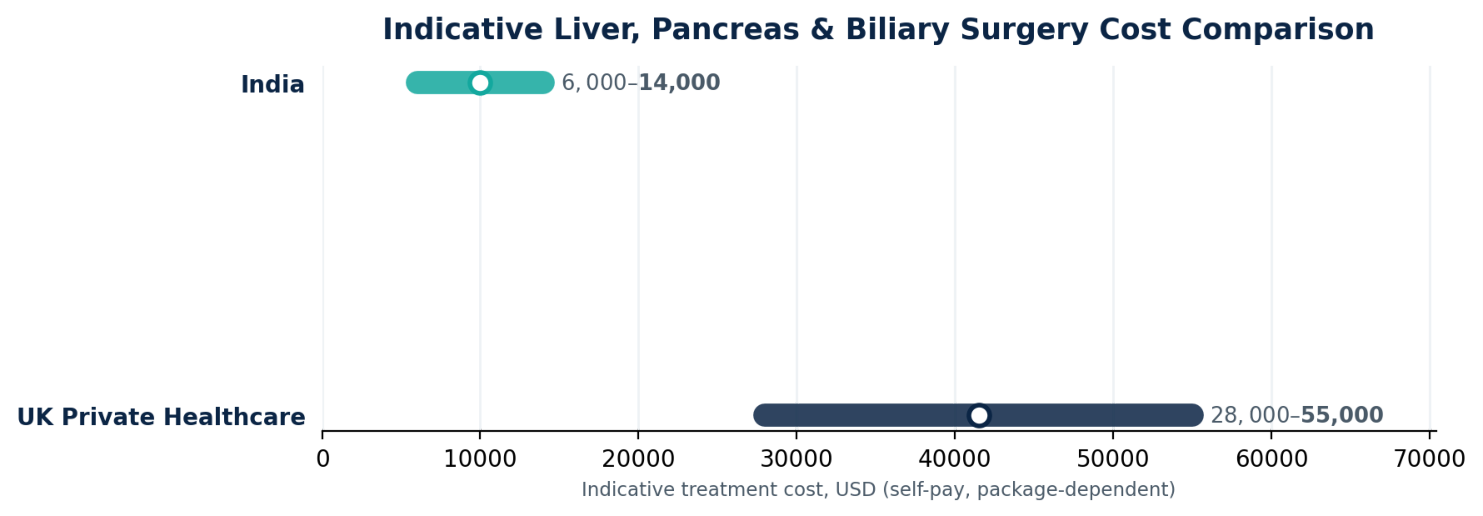
| Indicative Cost in India | US$6,000–14,000 (self-pay, package-dependent) |
| Cost Saving | 50–70% vs. UK private healthcare, package-dependent |
| Reviewed By | Medical Experts at Forerunners Healthcare Team · 15 October 2026 |
Liver, Pancreas & Biliary Surgery in India for United Kingdom Patients — Complete Clinical & Surgical Guide (Page 1)
Patients travelling from the United Kingdom to India for hepatobiliary and pancreatic surgery
Gallstones, bile duct stones and strictures, liver tumours, pancreatic tumours, pancreatitis, end-stage liver disease, bile duct cancer, hydatid cysts and liver abscesses
Laparoscopic cholecystectomy, liver resection, Whipple procedure and other pancreatic resections, bile duct reconstruction, liver transplantation, cyst and abscess drainage
Ultrasound, CT or MRI (including MRCP), liver function tests, tumour markers, endoscopic ultrasound or ERCP, biopsy
6–10 days after major hepatobiliary surgery
Approximately 16 days (varies by patient)
US$6,000–14,000 (self-pay, package-dependent)
50–70% vs. UK private healthcare, package-dependent
Medical Experts at Forerunners Healthcare Team · 15 October 2026
United Kingdom Patients — Ready to Take the First Step?
Share your scans, imaging and liver function reports for a MEDICAL CONSULTATION.